The fastest, realistic path into an AI engineer job in India in 2026 is: learn applied Python and one GenAI stack (LangChain or LlamaIndex, RAG, a vector database), earn one or two free foundational certifications, ship a single live production-deployed project instead of tutorial clones, then apply in parallel to both mass IT recruiters (TCS, Infosys, Wipro) and product companies or GCCs. India is short on AI talent relative to demand, and companies are hiring for applied skills and real projects over deep theory or a specific degree.
Why AI Engineering Is One of the Easiest Tech Jobs to Break Into Right Now
India's AI job market in 2026 is defined by one thing: demand is outrunning supply. The country's AI market was valued at roughly USD 9.51 billion in 2024 and is projected to cross USD 130 billion by 2032, and organizations across IT services, product companies, and Global Capability Centers (GCCs) are actively hiring AI talent while salaries keep rising. Roughly 90% of the AI engineering roles being filled right now fall under "Applied AI" — building and shipping systems on top of existing models — not research-heavy roles that require a PhD or years of theory. That's what makes the entry bar lower than most people assume: you don't need to invent a new architecture, you need to be able to build a working RAG pipeline or agent and deploy it.
The Skill Stack That Actually Gets You Hired
Employers are not screening for exhaustive ML theory. They're screening for a specific, applied stack. Python covers roughly 90% of daily AI engineering work, and everything below builds on it.
| Skill | Why It Matters | Where to Learn It Free |
|---|---|---|
| Python | Non-negotiable base language for almost every AI engineering task | Kaggle Learn, freeCodeCamp |
| LangChain / LlamaIndex | Orchestration frameworks used to chain LLM calls, tools, and memory in real products | Official docs + DeepLearning.AI short courses |
| RAG pipeline design | Semantic chunking and unstructured data parsing are the core of most GenAI product work in India right now | DeepLearning.AI, LangChain docs |
| Vector databases (Pinecone, ChromaDB) | Every RAG system needs one for retrieval | Pinecone/Chroma free tiers + docs |
| PyTorch or TensorFlow | Still expected for core ML/model-level roles, less so for pure applied GenAI roles | PyTorch/TensorFlow official tutorials |
| MLOps basics (MLflow, Kubeflow) | Shows you can take a model past a notebook into production | MLflow docs, Coursera audit mode |
| Cloud (AWS, GCP, or Azure) | Nearly every production AI system is deployed on one of these | Oracle OCI AI Foundations, Azure AI Fundamentals |
Step-by-Step: The Fastest Realistic Path From Zero to Hired
1. Get applied Python and one ML framework working, skip the deep theory first
Focus on being able to write and debug real code, not memorize proofs. You can go back for the math once you're employed and it's actually relevant to your role.
2. Pick up one or two free foundational certifications
Oracle Cloud Infrastructure (OCI) AI Foundations is completely free and needs zero prior experience. IBM SkillsBuild and IBM's intro AI engineering courses on edX are also free and carry weight because IBM is a major India employer. Microsoft's Azure AI Fundamentals certification is worth adding if you're leaning cloud-heavy.
3. Learn the GenAI stack that's actually hiring in 2026
LangChain or LlamaIndex, RAG pipeline architecture, and a vector database. This is the stack behind most of the applied AI job postings in India right now, and it commands a real premium over generic ML fundamentals.
4. Build and deploy exactly one real project
One live, monitored, production-deployed project beats ten tutorial clones every time in an interview. Deploy it somewhere real, keep it running, and be able to explain what breaks and why.
5. Put it where recruiters actually look
A clean GitHub repo with a real README and a working deployed link, plus a LinkedIn profile that leads with the project, not a list of course certificates.
6. Apply on both tracks at once
Mass-recruit through IT services campus and off-campus drives (TCS is targeting around 42,000 freshers in FY26, Infosys over 20,000, Wipro 10,000–12,000) while also applying directly to product companies, AI-native startups, and GCCs in Bengaluru, Hyderabad, Pune, and Delhi-NCR, which pay more for the same GenAI skill set.
7. Lead interviews with your project, not your syllabus
When asked to walk through your background, start with what you built and deployed. That's what separates you from the hundreds of other applicants who only finished courses.
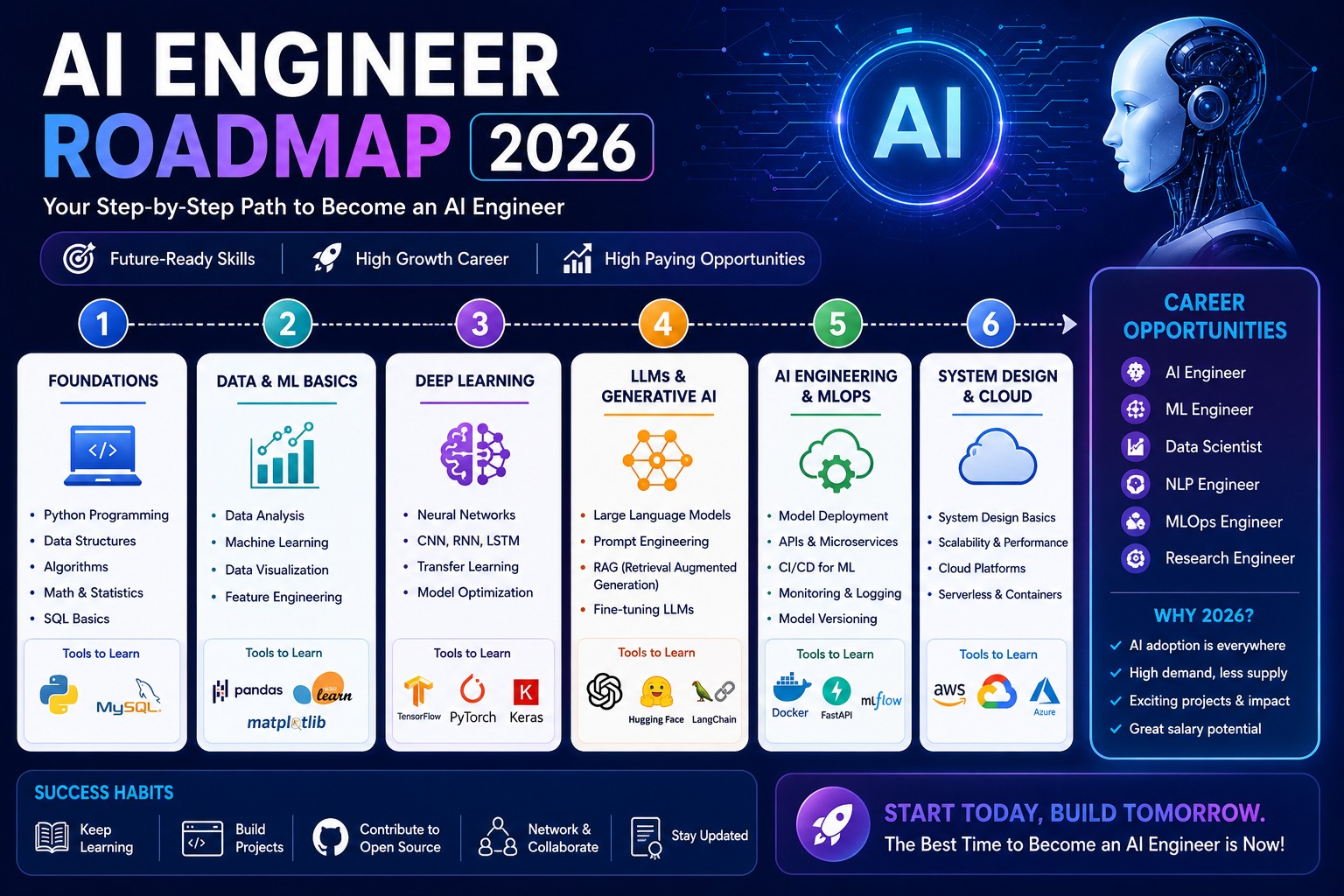 Source: shifttotech.co.in — AI Engineer Roadmap 2026
What Freshers Are Actually Earning in 2026
| Employer Type | Typical Fresher Pay |
|---|---|
| Mid-tier IT services (TCS, Infosys, Wipro) | ₹50,000–₹70,000/month (₹6–8.5 LPA) |
| General AI/ML fresher role, any employer | ₹5–12 LPA |
| GenAI specialist fresher with project portfolio | ₹8–12 LPA |
| Product companies / startups, strong GenAI portfolio | ₹80,000–₹1,25,000/month (₹9.6–15 LPA) |
| Mid-level (2–5 yrs) | ₹15–30 LPA |
| Senior, GenAI/MLOps/architecture | ₹30–60+ LPA |
Skills in Generative AI, LLM fine-tuning, MLOps, and AI agents command a 25–45% premium over generic AI engineering pay — which is exactly why the GenAI-specific stack above is worth prioritizing over broad theoretical ML knowledge if your goal is getting hired fast.
FAQ
What is genuinely the easiest way to get an AI engineer job in India?
Focus on applied skills over theory: Python, a GenAI orchestration framework (LangChain/LlamaIndex), RAG, and a vector database, backed by one real deployed project. Pair that with one or two free certifications (Oracle OCI AI Foundations or IBM SkillsBuild) and apply to both mass IT recruiters and startups/GCCs simultaneously.
Do I need a degree in AI or Computer Science to become an AI engineer in India?
Most postings prefer a Computer Science, AI, or related degree, but companies increasingly prioritize real-world experience, GitHub portfolios, and problem-solving ability over the specific degree. A strong deployed project and demonstrable Python/GenAI skills can outweigh a non-CS background.
How much does an entry-level AI engineer earn in India in 2026?
General AI/ML freshers typically earn ₹5–12 LPA. Freshers at mid-tier IT companies like TCS, Infosys, and Wipro tend to land ₹50,000–70,000/month, while product companies and startups pay ₹80,000–1,25,000/month for freshers with strong GenAI portfolios.
Which companies are hiring freshers for AI roles in India right now?
TCS (around 42,000 freshers planned for FY26), Infosys (20,000+ in 2026), Wipro (10,000–12,000), plus Cognizant, HCL, IBM, and AI-focused companies like Fractal Analytics, Mad Street Den, and Haptik, alongside GCCs expanding in Bengaluru, Hyderabad, Pune, and Delhi-NCR.
Is Python alone enough to get an AI engineering job?
No, but it's the foundation — it covers roughly 90% of daily AI engineering work. You still need at least one orchestration framework (LangChain/LlamaIndex), an understanding of RAG pipelines, and familiarity with a vector database to be competitive for GenAI roles specifically.
Are free AI certifications actually worth listing on a resume in India?
Yes, for freshers with no work history. Oracle OCI AI Foundations, IBM SkillsBuild/edX courses, and Microsoft Azure AI Fundamentals are free, require no prior experience, and carry recognizable employer names that recruiters filter on — but they should support a real project, not replace one.
How long does it realistically take to become job-ready as an AI engineer from zero?
Structured roadmaps built for the Indian market typically target around 10 months for someone starting from scratch, covering foundational programming through deployment and portfolio-building. Someone with existing programming experience can often compress this significantly by skipping straight to the GenAI-specific stack.
What's the difference between an AI engineer and a machine learning engineer role in India?
In practice, the titles overlap heavily in Indian job postings. "AI engineer" roles skew more toward applied GenAI work — RAG systems, agents, LLM integration — while "ML engineer" roles skew slightly more toward classical model training, math foundations, and MLOps, though most postings expect familiarity with both.
Further reading:
- Will AI Coding Agents Replace Developers? FAQ on Jobs, Skills, and the Future (2026)
- Context Engineering: The Core Discipline of AI Engineering in 2026
- Harness Engineering: Why the System Around the Model Matters More Than the Model
- Loop Engineering: Inner Loops, Outer Loops, and the AI Engineer's New Job