Quick answer: MCP (Model Context Protocol) is an open standard, originally created by Anthropic, that lets AI applications like Claude connect to external data, tools, and workflows in one consistent way — often described as "a USB-C port for AI applications." It's become the default way coding agents reach outside the chat window into your files, databases, and services.
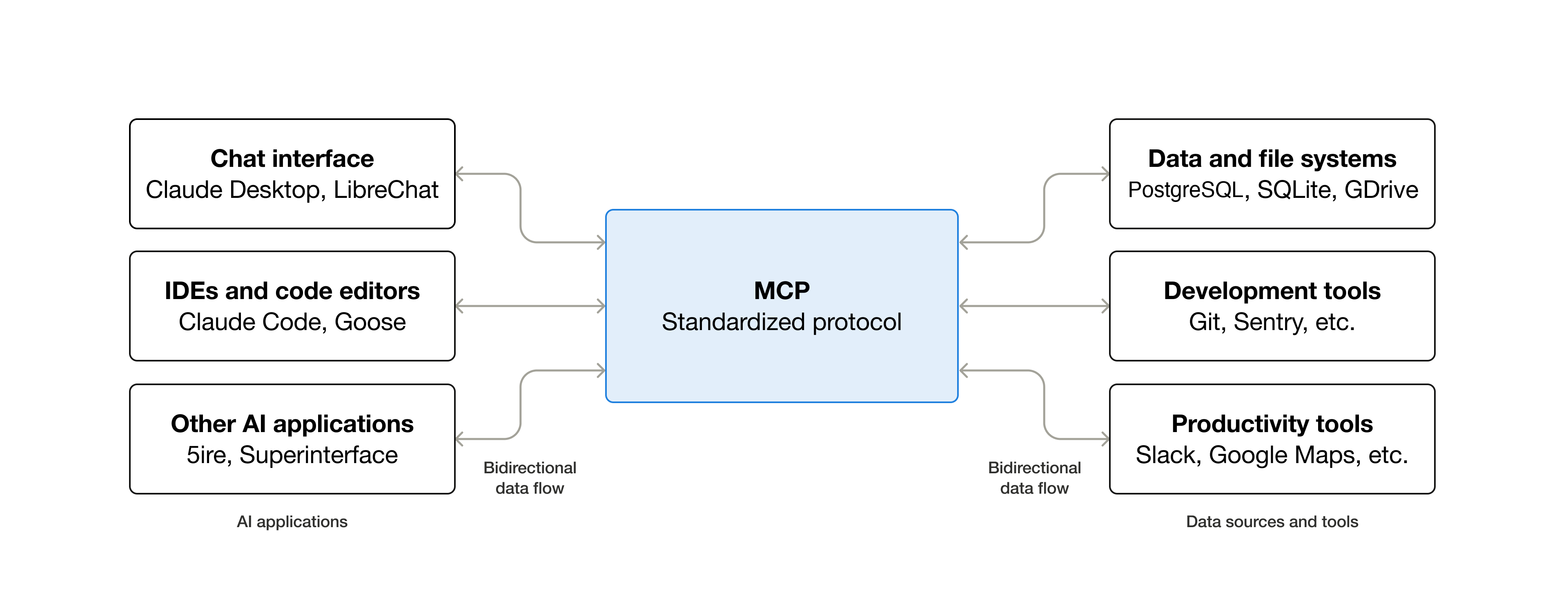
MCP explained simply. Source: modelcontextprotocol.io.
What is MCP in plain English?
An open-source standard for connecting AI applications to external systems. Instead of every AI tool needing a custom, one-off integration for every data source or service, MCP gives agents like Claude a single, standardized way to reach local files, databases, search engines, calculators, and specialized workflows.
Who created MCP, and who governs it now?
Anthropic introduced MCP in November 2024. Since December 2025, it's been governed by the Agentic AI Foundation under the Linux Foundation, co-founded by Anthropic, OpenAI, and Block, with AWS, Google, Microsoft, Cloudflare, and Bloomberg as platinum members — a genuinely cross-industry standard rather than one vendor's proprietary protocol.
How does MCP actually work?
MCP defines three roles: the host (the AI application itself, like Claude or an IDE), the client (the connector inside the host), and the server (the external system being connected to, which exposes specific data or tools). As of the July 2026 spec revision, remote MCP transport is fully stateless — every request carries everything it needs, with no persistent session to set up or maintain.
What can MCP actually let a coding agent do?
In practice: an agent can read your Google Calendar or Notion to act as a more personalized assistant, generate an entire web app directly from a Figma design, query multiple internal databases through chat, or drive external tools entirely outside the browser or IDE — all through the same standardized connection method rather than bespoke integrations for each.
Why does MCP matter specifically for developers?
It collapses what used to be N-times-M custom integrations (every AI app times every data source) into a single standard both sides implement once. Build an MCP server for your internal tool once, and it becomes usable by Claude, ChatGPT, Cursor, VS Code, and any other MCP-compliant client without extra integration work per client.
Which tools actually support MCP in 2026?
Broad support now spans both AI assistants and developer tools: Claude, ChatGPT, Visual Studio Code, Cursor, and dedicated MCP debugging tools like MCPJam all support the protocol, which is exactly the point — build a server once, integrate everywhere.
Is connecting an agent to more tools via MCP a security risk?
It can be, because every MCP server you connect is effectively new attack surface and a new source of untrusted input the agent will read and act on. Treat MCP servers the way you'd treat any third-party integration: only connect ones you trust, scope their permissions narrowly, and review what data and actions they actually expose before wiring them into an agent with broad autonomy.
Do I need to build my own MCP server to benefit from this?
No — most developers only ever consume existing MCP servers (for GitHub, databases, search, etc.) through a client they already use. Building a server matters mainly if you have an internal tool or proprietary data source you want agents to be able to reach in a standardized way.
Further reading:
No comments
Post a Comment