TL;DR: Claude Fable 5 briefly went dark worldwide after the US government applied export controls on June 12, 2026, following a report that the model could be prompted into demonstrating a software exploit. Anthropic shipped an upgraded safety classifier that blocks the technique in over 99% of cases, the controls were lifted on June 30, and global access was restored on July 1, 2026.
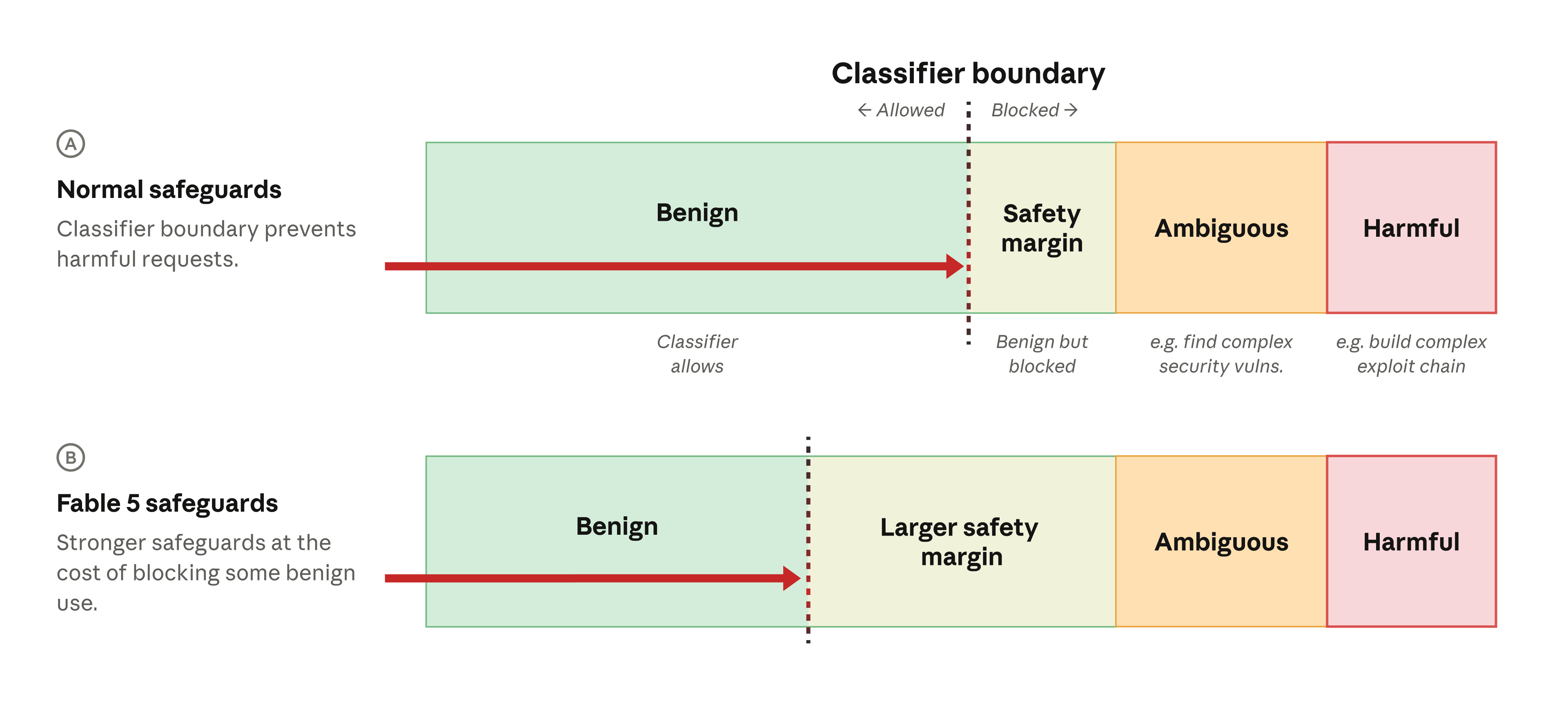
How Anthropic's cybersecurity safety classifiers work. Source: Anthropic.
What actually happened
Anthropic released Claude Fable 5 and Claude Mythos 5 on June 9, 2026. Three days later, the US government applied export controls to both models, which meant Anthropic had to restrict access to foreign nationals. Since there was no reliable way to verify a user's nationality in real time, Anthropic made the call to suspend access for everyone rather than risk violating the directive. That's why Fable 5 disappeared globally, not just for users in a specific region.
The controls stayed in place for about two and a half weeks. The US government approved restoring Mythos 5 access for US organizations on June 26, lifted the export controls entirely on June 30, and Anthropic restored global access to Fable 5 on July 1, 2026.
Why it happened: a cybersecurity jailbreak, not a new capability
The trigger was a report from Amazon researchers who found a way to prompt Fable 5 into demonstrating how to exploit a known software vulnerability — the kind of thing that falls under "routine defensive cybersecurity work" rather than some novel offensive capability. Anthropic's own testing found this wasn't unique to Fable 5 at all: every model it tested against the same technique — Claude Opus 4.8, GPT-5.5, Kimi K2.7, Claude Haiku 4.5, and Sonnet 4.6 — produced the same kind of exploitation walkthrough. In other words, the underlying vulnerability-identification behavior wasn't specific to Fable 5's "Mythos-level" capabilities; it was a general jailbreak pattern that happened to get reported against the newest model first.
The fix: a tighter safety classifier
Anthropic's response was to ship an improved safety classifier that blocks the reported bypass technique in more than 99% of cases, automatically redirecting flagged requests to Claude Opus 4.8 instead. This sits inside what Anthropic calls a "defense in depth" architecture:
- Safety classifiers — automated systems that flag potentially harmful cybersecurity requests as they happen, mid-conversation.
- A deliberate safety margin — the classifier is tuned to also trigger on some requests that are probably benign, trading a higher false-positive rate for a lower chance of letting a genuinely harmful request through.
- Extra margin specifically for Fable 5 — because it's the most capable model in the lineup, Anthropic accepted more false positives on it than on earlier models, prioritizing catching harmful requests over minimizing friction for legitimate ones.
A new way to score how bad a jailbreak actually is
Alongside the fix, Anthropic proposed a four-criterion severity framework for jailbreaks, developed with Amazon, Microsoft, Google, and Glasswing:
- Capability gain — how far beyond already-available tools the jailbreak actually reaches.
- Breadth of capability gain — how many distinct harmful tasks it unlocks, not just one narrow trick.
- Ease of weaponization — how much additional human effort is needed to turn the jailbreak into something actually usable for harm.
- Discoverability — how easily someone else could find or stumble onto the same technique.
As Anthropic put it: "There's currently no consensus in the AI industry on how to describe, in objective terms, the severity of an AI jailbreak." This framework is an attempt to give incident response — both inside labs and for regulators — a shared vocabulary instead of ad-hoc, case-by-case judgment calls.
Where availability stands now
- Fable 5 is accessible globally again on the Claude Platform, Claude.ai, Claude Code, and Claude Cowork.
- Pro, Max, Team, and select Enterprise plans got it included at up to 50% of weekly usage limits through July 7; after that it's available via usage credits.
- Access through AWS, Google Cloud, and Microsoft Foundry was expected to be restored shortly after.
- Mythos 5 is restored specifically for approved US organizations.
The bigger commitment: working with governments before release
Anthropic also committed to four ongoing practices with government partners going forward: giving national-security-relevant models pre-release government access and evaluation, sharing information on jailbreaks and misuse patterns quickly, dedicating resources to joint AI security research, and contributing to a voluntary industry-wide security standard. The episode is effectively a case study in why that kind of coordination matters — a two-and-a-half-week global outage of a flagship model is an expensive way to find a classifier gap.
Timeline
- June 9, 2026 — Claude Fable 5 and Claude Mythos 5 released.
- June 12, 2026 — US export control directive applied; global access suspended.
- June 26, 2026 — US government approves Mythos 5 access for US organizations.
- June 30, 2026 — Export controls lifted.
- July 1, 2026 — Global access to Fable 5 restored.
FAQ
Why was Claude Fable 5 taken offline everywhere, not just in restricted countries?
Because Anthropic had no reliable, real-time way to verify a given user's nationality against the export control requirement, so it suspended access globally rather than risk non-compliance.
Did the jailbreak reveal a capability unique to Fable 5?
No. Anthropic found that older and smaller models — including Opus 4.8, Haiku 4.5, Sonnet 4.6, and competing models like GPT-5.5 and Kimi K2.7 — could produce the same exploitation demonstration, so the issue was a general jailbreak technique rather than a novel Fable-5-specific risk.
Is Claude Fable 5 fully available again now?
Yes, as of July 1, 2026, on the Claude Platform, Claude.ai, Claude Code, and Claude Cowork, with cloud provider access (AWS, Google Cloud, Microsoft Foundry) following shortly after.
What is the "safety margin" approach mentioned by Anthropic?
It's a deliberate design choice to have the safety classifier also flag some harmless requests as a tradeoff for catching more genuinely harmful ones — accepting a higher false-positive rate in exchange for a lower false-negative rate on the most capable models.
Further reading: