TL;DR: in 2026, the hottest skill in AI engineering isn't writing better prompts — it's context engineering: deliberately curating everything an LLM sees on every inference call (system prompt, retrieved documents, tool definitions, memory, conversation history) so the model has exactly the right information, and nothing more, at the moment it needs it.
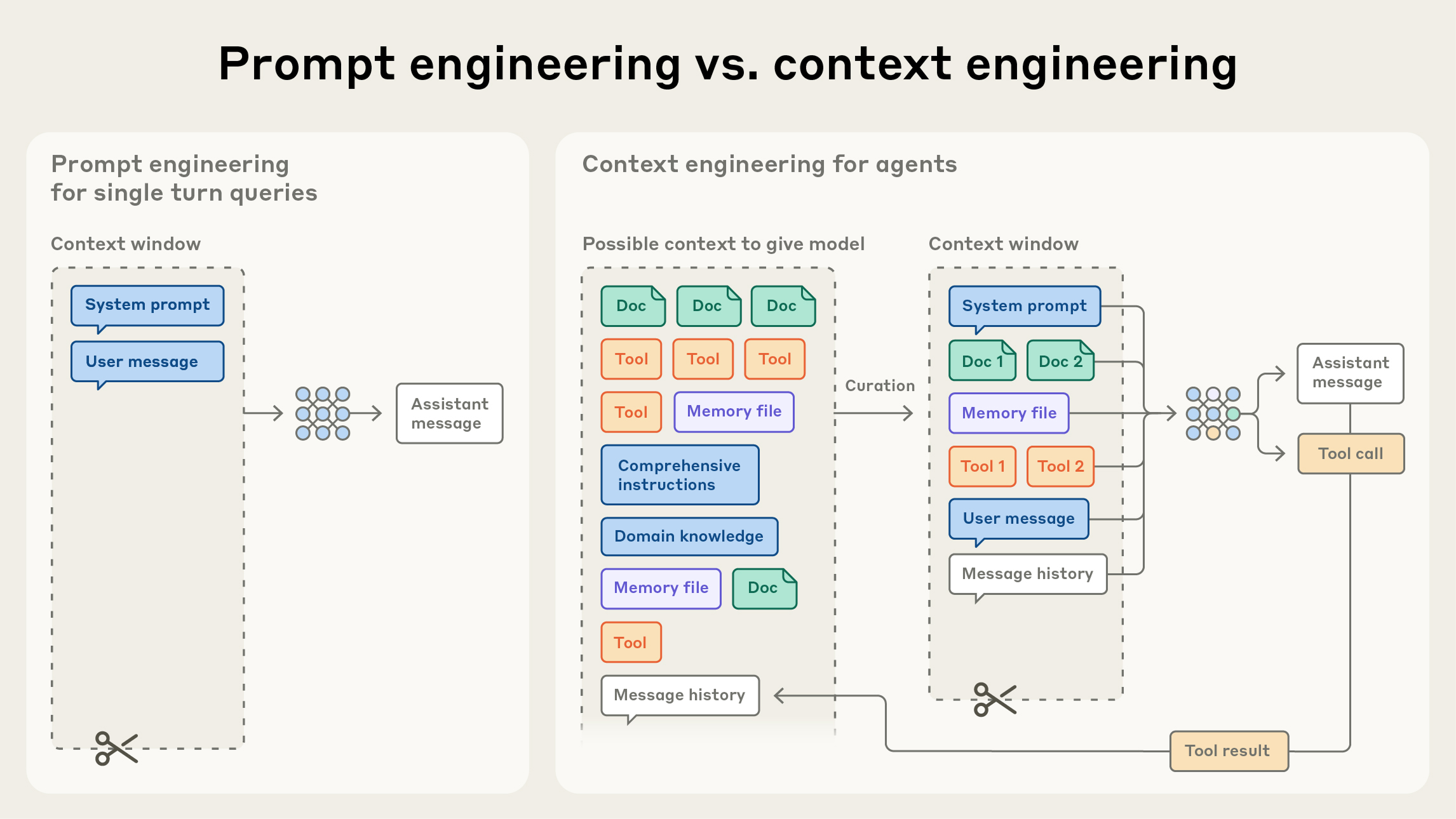
Prompt engineering vs. context engineering. Source: Anthropic Engineering.
Why "prompt engineering" stopped being enough
Prompt engineering treated a task as a single, cleverly-worded instruction. That model breaks down the moment you're running an agent across dozens of tool calls and multiple turns, because the real bottleneck isn't the wording of one prompt — it's what accumulates in the context window over an entire session. Anthropic's applied AI team frames context as a finite, expensive resource: every token you feed the model competes for a limited "attention budget," and stuffing in irrelevant history, bloated tool schemas, or duplicate retrieved documents measurably degrades output quality. Researchers call this degradation context rot — accuracy silently drops as token count grows, partly because a transformer's attention computation scales quadratically with sequence length.
The four things you're actually engineering
- Instructions / system prompt — behavioral framing specific enough to be useful, general enough not to become a brittle pile of if-else rules.
- Retrieval — pulling in external data via RAG, structured queries, or code-aware lookups, ranked and trimmed to the top-k most relevant results instead of dumping everything in.
- Memory — both short-term conversation history and durable, cross-session state, often kept as external notes rather than crammed permanently into the live context.
- Tools — a lean, non-overlapping set of functions. Every extra or ambiguous tool definition is tokens the model has to reason over on every single call.
Practical techniques teams are using in 2026
- Just-in-time retrieval — load data through tool calls only when the agent actually needs it, instead of pre-loading everything up front.
- Compaction — periodically summarize long conversation histories, keeping architectural decisions and discarding redundant tool output.
- Ordering discipline — place the highest-signal material at the very start or end of the context, since models attend less reliably to information buried in the middle.
- Sub-agent isolation — delegate a narrow piece of work to a separate agent with its own clean context, and merge back only a condensed summary.
FAQ
Is context engineering just a rebrand of prompt engineering?
No. Prompt engineering optimizes the wording of one instruction; context engineering optimizes the entire, ever-changing set of tokens an agent sees across a multi-turn, multi-tool session.
What is "context rot"?
The observed drop in retrieval accuracy and reasoning quality as the number of tokens in context grows, even when every token is technically relevant.
Who owns context engineering on a team?
Increasingly, a dedicated role: the person responsible for the architecture that decides what an agent gets to see, when, and in what order — distinct from whoever fine-tunes or prompts the model itself.
Further reading: