TL;DR: "loop engineering" was the buzzword of AI Engineer World's Fair 2026 for a reason: as agents take over more of the execution work, the human engineer's job is shifting to designing and supervising the outer loop — the feedback, evals, and decisions that keep the agent's largely autonomous inner loop on track.
The loop debate at AI Engineer World's Fair 2026. Via Latent Space.
Inner loop vs. outer loop
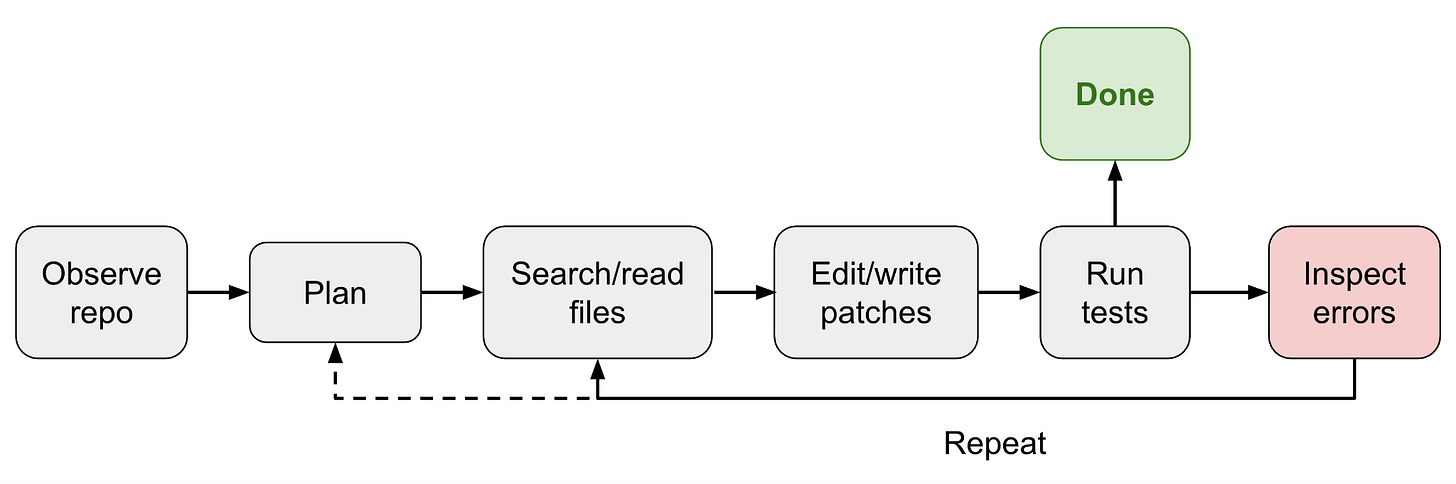
The inner loop is the agent doing the work: writing code, calling tools, iterating against test failures, largely on its own. The outer loop is everything that studies and steers that primary loop — feedback signals, evaluation results, human review, and course corrections. Roland Gavrilescu, co-founder of Introspection, describes the outer loop as "another system that studies and maintains the primary system," distinct from the inner loop that talks directly to users.
Why this reframes the AI engineer's job
Former Google engineering leader Addy Osmani put it simply: agents can run much more of the inner execution loop, but the outer loop is still engineering. OpenClaw creator Peter Steinberger described his own role in almost identical terms — the agent runs the inner loop, while he sets direction and makes decisions in the outer loop. The job hasn't disappeared; it's moved up a level of abstraction, from writing code line-by-line to designing the loop that decides what the agent should try next.
The debate: are agents ready to run loops unsupervised?
Not everyone agrees on how far this should go. At AIEWF's closing debate, Dex Horthy of HumanLayer argued that "the hype is outrunning the discipline," while granting that deterministic control loops (the kind Kubernetes is built on) are proven and safe. Geoffrey Huntley, creator of the Ralph Loop, called today's autonomous loops "frontier thinking" and compared engineers to locomotive drivers: the job now is less about laying every rail by hand, and more about keeping the locomotive on the rails once it's moving on its own.
What this looks like in practice
- Agents get wide latitude inside a bounded inner loop (edit code, run tests, retry on failure).
- Humans (or a supervising "autoresearch" system) watch the outer loop: aggregate evals, flag regressions, and adjust the agent's instructions or tools over time.
- Escalation paths exist for the inner loop to pause and hand control back up when it hits ambiguity it can't resolve alone.
FAQ
Is loop engineering the same as harness engineering?
They're closely related. The harness is the full system (tools, guardrails, memory, verification); loop engineering specifically concerns how autonomous execution is structured into inner and outer feedback loops within that harness.
Does loop engineering mean agents run fully unsupervised?
No — the consensus at AIEWF 2026 was closer to the opposite: full autonomy proved unreliable at scale, so engineers now deliberately stay in the outer loop rather than removing themselves from it.
What's a concrete example of an outer loop?
A system that runs an eval suite against every agent output, flags regressions, and periodically retrains or re-prompts the inner-loop agent based on aggregated results — without a human reviewing every individual action.
Further reading: